
Evaluating the Effectiveness of Academic Support on Postgraduate Learning & Engagement: A Diversity View
Introduction: context, participants and purpose
UK Higher Education has experienced substantial growth in international student participation. These students enrich postgraduate classrooms with their diverse linguistics, educational and disciplinary background, but they may also encounter unique challenges that may impact their academic integration e.g., academic writing standards, critical argument construction, independent learning and assessment requirements (Munna, 2022). Research indicates that international students’ academic integration can also be affected by uneven access to lecturer support. In Li and Shen (2025), students described feeling “left behind”, facing academic language barriers and finding a “one-size-fits-all approach” insufficient for their differing educational backgrounds, while also emphasising the role of lecturer support in building confidence and participation. These findings motivated our structured, assessment-linked approach to supporting a diverse postgraduate cohort.
This case study explores lecturer-led academic support in Business Analytics, an intensive 30-credit postgraduate module. In 2025/26, the cohort comprised of 88 students with a diverse cultural and educational background such as Business and Finance, STEM and other disciplines. The module delivery included 36 hours of lectures, two hours of seminars and eight hours of computer classes throughout the semester. The module employs a range of assessment methods to address students’ progress and motivate learning. Students are assessed by the completion of Bloomberg Market Concepts (10%), a Blackboard Test (20%) and an individual 4,000-word assignment (70%).
The assignment combined several layered demands: choosing a dataset, formulating a research question, engaging critically with related literature, selecting and justifying an econometric method, interpreting output, structuring an academic argument and responding to marking criteria. Previous teaching experience and patterns in earlier submissions suggested that many international students understood the analytical content but struggled to communicate it in the form expected of a UK postgraduate business assignment. Such expectations are often implicit rather than directly taught and cannot be treated as generic, transferable “study skills” detached from disciplinary practice (Lea and Street, 1998).
The study therefore asks:
- How do international students from different educational backgrounds perceive the effectiveness of lecturer-led support in completing an individual postgraduate assignment?
- What evidence is there that a scaffolded lecturer-led support program contributed to students’ learning, engagement, and academic performance?
Intervention and data collection
To support students with the individual assignment, three additional optional sessions were delivered across the semester. Instead of offering generic study-skills workshops, each session focused on a specific aspect of the assignment, providing targeted support at different stages of students’ preparation. The focus was on whether particular forms of support were especially valuable to students less familiar with UK postgraduate standards.
Session 1 focused on academic writing skills. Specialists from the Centre for International Training and Education (University of Leicester) explained how to interpret the brief, construct a sustained argument, develop a critical rather than descriptive voice, integrate evidence and connect claims to the marking criteria.
Session 2 focused on the responsible use of generative AI. We invited an external Senior Lecturer in Business Analytics who discussed its use under the module’s amber policy, whereby AI could support the research and development of the individual assignment, provided its use was appropriately acknowledged, However, the final submission had to demonstrate students’ own critical thinking and application of knowledge. The session also considered methods for checking reliability, risks of inaccurate or fabricated output, academic integrity and the continuing importance of human judgement. The emphasis was that AI could support a process, but could not replace the student’s responsibility for methodological justification, interpretation and the final argument.
Session 3 was designed as a student-led, integrated assignment question-and-answer session. Students were informed of the purpose of the session in advance and encouraged to prepare questions relating to the individual assignment. During the session, the module leaders responded to students’ questions, clarified assessment expectations and, where relevant, connected these discussions to key aspects of the earlier academic-writing and AI-literacy sessions. Positioned closer to the submission deadline, the session provided an opportunity for students to consolidate their understanding and address any remaining areas of uncertainty.
Attendance for each session was 64, 49 and 69 students respectively. At the end of each session, students completed an anonymous questionnaire using a seven-point Likert scale, where 1 represented “strongly disagree” and 7 represented “strongly agree”. In total, the analysis included 42 responses for Session 1, 23 for Session 2 and 16 for Session 3. The questionnaire recorded that most of the students had completed their undergraduate education outside the UK and mainly came from Business and Finance backgrounds, with smaller numbers from STEM and other disciplines. The questionnaire included open-text questions as well.
Findings and discussion
Perceived usefulness and differential benefit
Students rated all three sessions positively. Composite median ratings were 6.00 for academic writing, 5.86 for AI literacy and 6.00 for the final Q&A. The key finding was that the pattern of benefit depended on the content of the session rather than being uniform across all forms of support. In particular, for the academic-writing session, the students who did their undergraduate degree outside the UK reported a higher median rating than UK-educated students (6.17 compared with 5.00). This suggests that making UK-specific academic conventions explicit may offer greater immediate value to students with less prior exposure to those conventions. In the AI-literacy session, ratings did not differ significantly by educational background. This may reflect the relative novelty of generative AI for students regardless of their educational background, meaning that both groups had similar support needs. However, this finding should be interpreted cautiously given the small number of UK-educated respondents (n=7), which limits the strength of comparisons between groups.
Programme coherence
In Session 3, students were asked whether the content complemented the previous support sessions, with responses producing a median of 6.5, the highest single-item median in the study, and 94% agreement. This suggests that students perceived the three sessions as a coherent and cumulative programme of support. This scaffolded approach broke the complex individual assignment into more manageable stages, made assessment expectations more explicit, and supported students in developing their understanding and confidence as they progressed towards the final submission.
Students’ comments
Students’ qualitative feedback provided further evidence of the perceived impact of the support programme. Students particularly valued the practical and accessible nature of the sessions, with one describing the additional workshops and guidance as “extremely helpful in improving both my understanding and confidence”, while another reported that the “practical demonstrations and step-by-step explanations made many complex areas much easier to understand and apply”. The perceived value for the international student cohort was also evident, with one student calling for “promote more [of] these kind of sessions for foreigner students”. Feedback from the AI-literacy session indicated broader learning beyond assessment preparation. Students highlighted greater understanding of ethical AI use, noting, “I got to know more about the ethical use of AI” and how to avoid “inaccurate information and plagiarism”, with another stating, “I am ready to put this knowledge into the project”. Collectively, these comments suggest that the programme supported students in developing greater understanding and confidence, applying learning in practice, and engaging more responsibly with generative AI.
Performance evidence
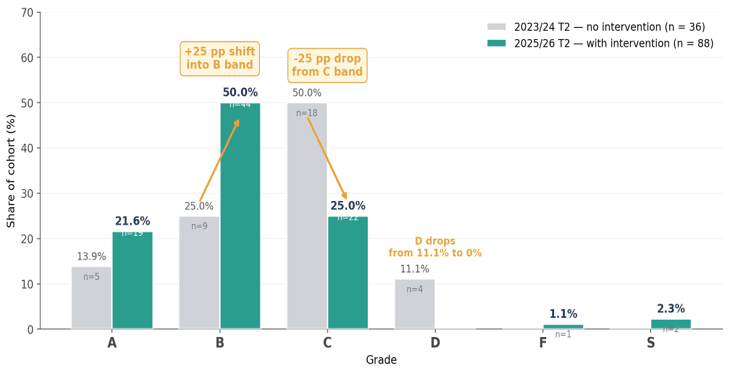
The grade comparison showed a substantial upward shift (Graph 1). The combined proportion of A and B grades increased from 38.9% in 2023/24 Term 2 to 71.6% in 2025/26 Term 2. The B band increased from 25.0% to 50.0%, while the C band fell from 50.0% to 25.0% and the D band disappeared. This pattern is consistent with the survey evidence that students found the support useful. Nevertheless, the comparison cannot establish causality. Although the grade distribution improved following the introduction of the support programme, this change cannot be attributed solely to the intervention. Cohorts may differ from year to year in prior attainment, composition and overall academic ability, and these differences cannot be isolated using the available data. The increasing use of generative AI may also have influenced students’ approaches to assessment; however, AI was not entirely external to the intervention, as responsible and critical AI use formed the focus of one of the three support sessions.
Graph 1: Students’ performance (click to expand)
Conclusion and implications for practice
Overall, this case study demonstrates the value of structured, assessment-focused support for diverse postgraduate cohorts. Making assignment expectations explicit reduced uncertainty around unfamiliar academic conventions. Importantly, students’ feedback highlighted not only improved understanding but also greater confidence and ability to apply their learning. For students transitioning between educational contexts or disciplines, including those from STEM backgrounds, such support can help make postgraduate expectations more accessible. However, the present evidence is limited by the small and unequal survey samples, particularly the low number of UK-educated respondents. The study will therefore be extended into 2026/27 to examine whether the patterns observed are replicated across a further cohort and to strengthen the evidence base for the intervention.
The findings point to a clear pedagogic principle: rather than assuming that students understand assessment requirements, educators should make expectations explicit, scaffold support across stages and enable students to approach assessment with greater confidence and independence. This perceived impact is captured by one student’s reflection: “I truly appreciate the time and energy invested in ensuring students' success and I believe many of us have benefited greatly from the knowledge and support provided throughout the semester.”
Acknowledgements
We thank Dr Marios Kremantzis, University of Bristol, for designing and delivering the AI-literacy session, and Hania R. C. Orszulik from the Centre for International Training and Education, University of Leicester, for the academic writing session.
References
Lea, M. R., & Street, B. V. (1998). Student writing in higher education: An academic literacies approach. Studies in Higher Education, 23, pp. 157–172. https://doi.org/10.1080/03075079812331380364
Li, M. and Shen, Z. (2025) "Navigating new waters: the academic learning experiences of international postgraduate-taught students in UK higher education", Innovations in Education and Teaching International, pp. 1–14. https://doi.org/10.1080/14703297.2025.2459655
Munna, A. S. (2022) "International students’ learning experience on global curriculum", Journal of Education, 202(3), pp. 243–254. https://doi.org/10.1177/0022057420972063
↑ Top