
Student Blogging as Co-Creation in Economics Education
This case study describes The EconBlogger Project, a co-creation initiative embedded in two economics modules at Queen Mary University of London. Students write and publish blogs that apply economic theory to real-world issues of their choosing. They are guided by peer mentors, and the blogs are reviewed by the module organiser before publication. Since its initiation in 2024, the project has produced 30 student blogs with over 750 views, and selected posts are used as case studies in lectures and seminars.
Background
Economics undergraduates often engage with theory in a largely receptive mode, mainly by reading, listening, and reproducing ideas in assessed work. Writing for a public audience sits outside the normal module diet, yet it requires students to do something that exams and written assignments do not always demand: explain economic reasoning clearly to a non-specialist reader, in their own words, on a topic they have chosen themselves.
The EconBlogger Project began as an attempt to create a structured route for students to do exactly this. The project also builds a peer mentoring layer into the module that would benefit both the students being guided and those doing the guiding. The project operates within first and second-year Economics modules at Queen Mary Business School, with cohorts typically ranging between 80 and 150 students. Participation is voluntary and additional to assessed work.
Method
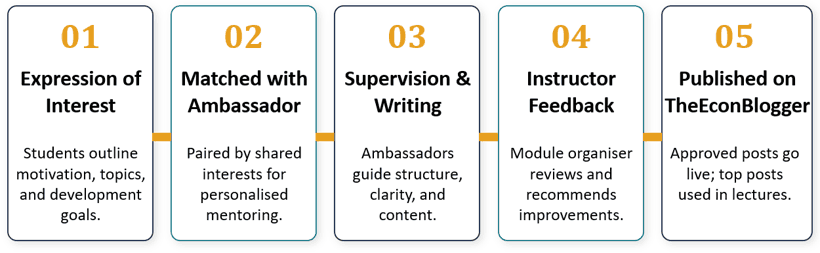
The project runs through a five-stage process. Students first submit an expression of interest, outlining their motivation and the topics they wish to write about. They are then matched with a Blogging Ambassador, an experienced student mentor, usually from a higher year, on the basis of shared interests. During the supervision and writing stage, the Ambassador guides the student through drafting, offering feedback on structure, clarity, and how well the economic concepts are applied. The student then submits a final draft to the module organiser for review and any recommended revisions before the blog is approved for publication on The EconBlogger, the project’s public site. Selected posts are subsequently used as illustrative case studies in seminars, so the student-authored material feeds directly back into formal teaching.
The roles within this framework are distinct but interdependent. The module organiser designs the process, reviews all drafts, approves publications, and integrates blogs into teaching. Blogging Ambassadors supervise student bloggers, offering feedback at each stage. A Senior Blogging Ambassador coordinates the Ambassadors themselves, providing a further layer of peer leadership if required. Students who participate as bloggers are the primary co-creators: they bring the topics, apply the economic analysis, and produce the output that ultimately reaches the module cohort.
Topics covered by students have included London rent prices, government intervention, market failure, artificial intelligence, monopoly power, counterfeit fashion, and the US budget crisis among others. The range reflects both the scope of the modules and the genuine breadth of student interest.
Outcomes
By the time of writing this case study, 30 blogs have been published, and the project site has accumulated over 750 views. Several posts have been used in seminar discussions as case studies.
Students who have participated as bloggers have reported that applying economic theory to something they chose changed how they engaged with module content. Two of them presented their experiences at the Queen Mary Festival of Education and the Northeastern University ExperienceED Festival. Students reflected on what the project had meant for their learning and professional confidence. One student noted that recruiters had asked about her involvement in the project, giving her an opportunity to highlight her leadership role and explain how the experience had enriched her learning and professional development.
For Blogging Ambassadors, the experience of guiding others has consistently deepened their own subject knowledge. Explaining a concept to a peer who is still developing their understanding requires a level of clarity that reviewing lecture notes does not.
Student reflections in their own words:
"Writing about something I’m interested in through an economic perspective was a great learning experience and overall quite rewarding."
"Writing about topics like rent prices in London, taxation and subsidies, and the economics of counterfeit fashion allowed me to bridge the gap between academic concepts and real-life scenarios. … the collaborative aspect of blogging - sharing my ideas with peers, receiving feedback, and working on joint posts - added a social element to the learning process."
"The reflective blog challenged me and made me more self-aware of my revision techniques. I identified exactly how to improve."
Challenges and lessons learned
Students often arrive with strong topic ideas but do not always follow up with Student Ambassadors after the initial matching. As a result, some collaborations lose momentum and come to an end shortly after the initial contact.
A related challenge is matching students and Ambassadors. Where the match works well, the supervision is collaborative and often results in strong and high-quality blogs. Where it is more transactional, the output tends to be competent but unremarkable. We have addressed this partly by giving students and Ambassadors more input into the matching process, and partly by encouraging Ambassadors to co-write with students where the match is less natural, rather than simply reviewing drafts at a distance.
The integration of student blogs into teaching has required some deliberate effort. Early on, it was tempting to reference student work in seminars in passing rather than treating it with the same seriousness as any other case study. Making the blogs a genuine part of seminars may have helped students recognise the value of participating in the project and see their contributions as an integral part of the learning experience.
Conclusion
The EconBlogger Project demonstrates that a structured, low-resource co-creation model can produce meaningful outcomes in learning, peer mentoring, and curriculum enrichment simultaneously. The key ingredients are student choice of topic, a staged process that makes public writing feel achievable, and a peer mentoring layer that creates value for mentors and bloggers alike. The blogs students produce become part of the curriculum of the module that current and future cohorts can learn from.
The project web site is publicly accessible at theeconbloggerproject.blogspot.com.
↑ Top